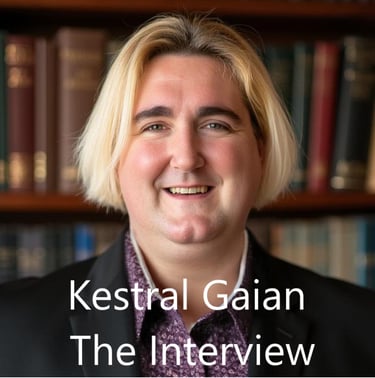
Kestral Gaian - The Interview
This first episode of 2026 is different from my usual episodes, as I was delighted at the end of December to record an interview with Kestral Gaian. And this is that interview.
Carolyne Well, hello Castro, and welcome to Trans Wise Trans Strong.
Kestral Hi there. It's really nice to be here.
Carolyne Right, so, ah, well, let's start as, as we always do with interviews with the first question. So I believe you recently moved from London to Ayrshire on the west coast of Scotland, and has this change of location had an influence upon your work?
Kestral Ah hugely, the change of location has had an impact on, on everything in my life really. I've gone from the hustle and bustle of London life to a sea view, erm, and err, a really different community Ayr is such a wonderfully friendly and welcoming place. Err, and it's just been so nice to get to meet a whole new set of people and explore a different landscape.
It's, It's given me more time to pause, life feels a little bit slower up here, which is really nice because it means when I sit down to write, the writing doesn't feel as time boxed, as restricted. It feels really open, like I've got a chance to, to really reflect on the stories, on the characters and the stories that I'm telling, which is lovely.
Carolyne Yeah. Erm I think you've lived in different parts of Britain. Have you found somewhere? I mean, you already said the difference where you're living now in terms of acceptance of the LGBTQIA+ community.
Kestral I think I've been really lucky in most places that I've lived, and I have lived all over. I grew up in the Midlands, sort of in the 80s and 90s, where acceptance and awareness wasn't great.
Carolyne Yeah.
Kestral And that, that was probably the, the worst time I had. I think that was as much to do with the era as it was, err, the location. Err, but since then I've lived in London, I've lived in Reading, I've lived on the south coast, down in Southampton, erm, all of those places, very accepting, lots of queer spaces, which is great. Erm, even then I spent some time living in Yorkshire, and that was a really, uh, friendly, really accepting place as well.
I think one of the nice things about the, I mean, I've only lived up here in Scotland for, for 2 or 3 months, but one of the really nice things about it so far is how welcoming it's felt. Err, not just in terms of, erm, welcoming as a as a person, as a human, as a, as a writer, but also, um, as an LGBTQ+ person. The fact that there are community groups, the fact that people seem friendly, welcoming and accepting of kind of all of us and those kind of differences have been really nice.
Carolyne Yeah. I mean, I recently well, actually I say recently I've been living in Southend since 2014 and yeah, likewise, I found a difference here. In fact, it was really my move to Southend where prompted me to finally come out as a trans woman in my mid 50s, because the acceptance none. As I say, erm, I think London, you know, is a huge city. And whilst I think there is acceptance, there's pockets of, you know, less accepting people I think.
Kestral Yeah so,
Carolyne So, yeah, please.
Kestral I think so, it's always wonderful to find a space that, that, erm, that it allows you to live your truth and discover who you are and take the time to, to be able to do that in a low pressure environment, which is lovely.
Carolyne Definitely, now, I believe there's actually a lovely story about how you came to choose your name. So actually tell our listeners about that.
Kestral Yes, so, err, my name and I chose both my, my first name and my surname, um, really came about well, sort of from the age of ten, really, I had been using this name online a little bit when I first started exploring the internet and kind of honored my inner child by choosing to live by it. Erm, as an adult when I then changed my name, but there's err, kind of a distinct difference between my first name and my surname.
So my first name, Kestral, is obviously it's a bird, it's a bird of prey, but the Kestral is such a beautiful bird. It's from all the of all the birds of prey, it's very gentle, it's very stoic, it kind of scans around and just observes life, erm, and I was also a very huge fan of the book, “A Kestrel for a Knave”, and of course, the Ken Loach film “Kes”, that was, uh, created as a result of that.
They they had a huge impact on my upbringing, sort of how I saw the world. So Kestral always felt like such a natural, erm, name to choose and to call myself, which, uh, which I always just found, err, felt felt like home for me.
Gaian is, uh, almost the opposite, it's, er, where kestrel is a bird, very much in the air, in the sky, erm, Gaian is Gaia is the Earth is the ground is very grounding, so it's really a reminder to myself that no matter how high I fly up in the clouds and how much time I spend just watching and observing life. I also have a part of me that needs to remember that I live on this planet, on this earth, and I need to stay grounded and connected to it, and not just kind of distant from it and observing it.
And it's a nice way for those two parts of myself to to come together. My name is really a reminder and a promise about how I want to to go through and sort of live life. And after I chose that name, I wrote a poem about that called “Birds and Humans”, that a very good friend of mine put to music and created a song.
Carolyne Oh Lovely.
Kestral Erm, so there's a piece of choral music called “Birds and Humans”, that is essentially the story of my name and it, you know, everything that I just said to you, but in a slightly more poetic way.
Carolyne Oh that’s lovely. It's really lovely. Now, moving forward, I think er we come to in your life history, as it were, publishing is 2016 when you published your first solo collection of poetry, Counterweights. Now, what were the themes that you were exploring in that collection?
Kestral Yes, that feels like so long ago now. But,
Carolyne Yes indeed.
Kestral yes, “Counterweights” was published very shortly after I kind err publicly came out. Um, it wasn't, um, wasn't. Shortly after I'd came out to kind of friends and family, but I was I'd had just at that time started being more open about my gender identity to the rest of the world and to people at work. And I'd started changing my name and kind of socially transitioning and doing all of that stuff in sort of 2015, 2016, just as the book was coming together.
And that had a huge impact on how I was seeing the world. And I had a whole collection of poems that I had written over sort of 15 years before that, that seemed to really hint at a kind of dual layer of observing things. And there's there's always the kind of surface of what you see. And then there's the story behind it, or the kind of story that's not told.
And so “Counterweights” was a book all about the duality of life, of human nature, of the buildings and the world we see around us. So there are poems in “Counterweights” that are about buildings that, um, were, you know, designed for one thing, but ended up getting used for another, or, erm, roads that started to get built and then stopped halfway.
Carolyne Yeah.
Kestral And, you know, all of the kind of stories and the complexities behind that, but also, you know, relationships and people that seem to be one thing and then end up being another or, you know, the identities that we thought we had and then the ones that were really beneath the surface once we began to explore that.
Carolyne Yeah, yeah.
Kestral Um, so it's really about that kind of balance, those counterweights. And, you know, one thing is held up and the other is held down, and
Carolyne Yes.
Kestral then they flip and and can do that, but they're never, ever quite on the same level.
Carolyne Same level.
Kestral Em, so it's a, a collision that that particular poetry collection is split into sort of three parts. There's erm, Concavity, which is a kind of look inward at kind of who we are and the people we are. Erm, and then there is Convexity, which is a look outside of the world, that the kind of the buildings, the streets, the, the cities we live in. And then there's Complexity, which is just the mess of everything else that exists in the world.
Carolyne Yeah, wonderful. Now, um, I think we're moving forward again. So doing a little jumps in in in time to 2022, which saw the publication of Hidden Lives, which is a powerful story of friendship, loss and trying staying true to oneself. And it's in the adult, uh, young adult fiction genre. What was it in particular drew you to that genre?
Kestral So when I started writing, I was young and I loved writing and telling stories. I've always written both poetry and, err, and fiction, but a lot of the fiction I had written before “Hidden Lives” came out was just sort of short form little stories, that kind of thing. Um, but I was realizing the older I got that there were so few role models growing up that were like me. There were no nonbinary characters in books there. There were trans characters in the media, but they were really punchlines rather than, you know, fully formed characters or people to look up to.
Carolyne Yeah.
Kestral There were no real sort of gay or lesbian fiction in the school libraries in the 80s and 90s, as we know there are there were laws that prevented that from happening.
Carolyne Indeed
Kestral And, it was really, um, that that inspired me to think, well, maybe some of the stories that I write could be for, uh, for a younger audience. Maybe I could create some stories that I needed when I was younger and kind of fill that gap that I didn't have with some things that, that, that I might have found useful at the time and try and break that cycle of not having positive role models and positive representation, uh, in the books that we read. So it was really my first kind of dipping of my toe into young adult fiction, and I was very pleased that it developed into a book that was then publishable. And, um, and that people enjoyed, uh, which, you know, was was hugely meaningful to me, people who read the book and then were saying to me, oh, you know, I really enjoyed that story. It was great, I felt, you know, represented there, um, meant the absolute world, um, and really inspired me then to, to keep going and think about, okay, well, what what could I do next?
Carolyne Yes. Yeah. I think what you're saying about this idea of positive role models, I mean, I think like myself and I think others who perhaps come out later in life and certainly growing up in the 70s, the concept of a positive, real world view of trans, well, it's just nonexistent. And yeah, I think if when I was young, if I could have found a book that says, well, some people gender identity differs to what they were assigned when when they were, you know, on their birth certificate, I would have certainly found helpful. And I think, as you say, the fact you've written that I'm sure there are there must be many nonbinary people, you know, young adults reading is thinking, oh, wow, this is you know, this is a this is a truth.
Kestral Well, hopefully.
Carolyne Yeah I think yeah, definitely. Thank you. I mean, I'm speaking of, um, you know, young adult fiction. I mean, as I say, as the name implies, it's for young adults, but, I mean, in the 90s and late 90s, early 2000, um, I'm certainly was aware that the Harry Potter books were being marketed towards adults, you know? And what would you think is the attraction for adults of YA fiction?
Kestral Yeah, I think, you know, young adult fiction is almost a bit of a misnomer because it's not just for young adults.
Carolyne Yeah.
Kestral And I think there's a huge draw for adults increasingly so even more now than in the late 90s, for adults, you want to read young adult fiction, and and I think there's a really simple reason behind it. And I think it's just it's more accessible and it's, it's it's more hopeful to read. We live in a world where we are bombarded by negativity all the time, the life is dark and gritty and difficult for most people.
When we think about the cost of living crisis and the economy, and we think about global warming, and we think about all of those things and housing scarcity and mold issues and houses and all of that, we live in a gritty, dystopian world. So the last thing that people want to do when they get home is escape into another gritty dystopian world,
Carolyne Yeah.
Kestral that's a bit too much like the one they live in, and I absolutely think there's a place for that, and that's great, and I'm a fan of a gritty dystopian movie as much as the next person. But when it comes to books, books are such an offline escapism, there's such a you really enter another world when you open a book or open an e-book even, or pop on some headphones to listen to an audiobook.
When you enter another world is a bit of escapism, it feels good to escape to an easier place and a place that is more accessible, and a place that is is good and sort of easier to digest. And I think that's one of the great things about young adult fiction. It's not watered down adult fiction at all, but the kind of general themes of it and the accessibility of the writing, it's not hard work to read, and so people get that kind of really great, really light, really easy escapism from the kind of gritty world that we find ourselves in the rest of the time.
Carolyne Yeah, now, you actually alluded to, um, in the 80s that she was gay and in school as well, you know, you were not told about it and which you actually addressed in 2023 with your book, 28 stories from section, from the, Stories from the Section 28 Generation.
Now, I think the section 28, perhaps some viewers, perhaps younger, or perhaps listeners from abroad, may not know the significance of section 28, which in itself sounds somewhat dystopian. And in point of fact, it probably was a bit so, yeah, but perhaps you would like to let people know why was section 28 so impactful in the LGBTQIA+ community?
Kestral Section 28 was a law that was in effect from 1988, right through until 2003, that effectively banned schools, doctors, public organizations, anyone that had anything to do with young people, from acknowledging the existence or validity of same sex relationships or supposed non-heterosexual or non-heteronormative relationships.
So essentially, gay men, lesbians, bisexual people, pansexual people, queer people in general, trans people err. Those were, it wasn't that they were banned, but it was illegal for anyone to talk about it. And that was worse, because there was a complete lack of education, you know, anything that could remotely be linked to that was stripped out of schools or doctor's offices.
If you asked the teacher or a doctor and said, oh, I, you know, I'm having these feelings and they couldn't answer them, they would lose their jobs. And there was a real fear and stigma around that. So for for a whole set of people going through schools, they were going through school at a time where who they were, the feelings they had on the inside.
We thought, you know, I remember thinking, I'm the only person in the world that feels like this, because there was no internet and none of the adults or institutions in our lives would acknowledge that it was even a thing. Um, so it it just we completely lacked the language to be able to describe who we were or process our own feelings. It left a generation or generations of really, um, you know, emotionally stunted, really difficult, really kind of people with really complex emotional needs because of this, um, this kind of silence, this deafening silence that section 28 created.
Now, of course, when it got repealed in 2003, it wasn't like they said, right the laws changed now, we'll educate everyone about it. The law got changed, but there was no further guidance to schools, so it kind of carried on. The law had been changed, but things didn't change overnight, and there are some schools even now that still operate as if section 28 were in effect, because they just don't know how to do anything different, and they're still scared of what that might look like if, err, you know, if they were more open about it.
And some schools are great and have done some really lovely things and have, you know, queer alliances for, for, um, queer students and things like that, but. It is still, we are still very much living under the long shadow of section 28, and that it was such an insidious, such an awful law. And that's really why I was compelled to, to create this book, so, so 28, the book that that I released in 2023 to mark the anniversary of the or the 20th anniversary of the law being repealed, was a collection of stories, poems, letters from people that were impacted by section 28 as a law.
So it contained stories from teachers and from from queer teachers who were suddenly silenced or ostracized because of section 28, from from people who were young people at the time, like myself, who went through the education system with section 28, in effect, uh, from people who were campaigning to get it repealed, um, and were campaigning to try and stop it coming in in the first place, although obviously they failed and it did become law. And people who went to school after section 28,
Carolyne Yeah.
Kestral are still talking about the impact that the kind of shadow of the law had. Um, so it was a really important way of trying to shine a spotlight on those untold stories, really as a way of being able to say to the world, look, this is what this is, the actual impact that these laws have. Let's not make new laws that replicate this, because, look, we don't want to do this to people all over again.
Carolyne Yeah. And it's interesting saying about do this all over again, because in April this year, David Tennant was interviewed on an ITV series called The Assembly, with a wonderful group of diverse people. And there they were asked a question in respect of the Supreme Court ruling in terms of how they, which reinterpret the Equality Act 2010 and David Tennant and I kick myself is not making the connection personally.
He likened it to section 28, I mean, what are your thoughts on on that ruling by the Supreme Court's reinterpretation, as it was of the Equality Act 2010?
Kestral I mean, I have so many feelings about that, err that particular Supreme Court ruling, and I think it's sad and shameful that it has happened and that we are taking steps backward in this world rather than taking steps forwards, particularly in the UK at the moment. And I think David Tennant was absolutely right, the the chilling effect that these laws have, restricts conversation, it makes topics of conversation off the table.
The fact that there are there is guidance for schools around how not to talk about trans issues, and the wording in some of these documents is exactly the same as the wording against, err, gays, lesbians and bisexual people in in 1988. It really is the same sentiment wrapped up in 21st century clothing. Erm, and we absolutely have to fight against it, just like there were groups of heroic people who tried to fight against section 28.
There absolutely must be groups of us that fight against these new laws, and I'm sure that the Supreme Court ruling last year was not the last we've seen of these law changes, and we may not always succeed. Section 28 still became law and was the law for a long time, in spite
Carolyne Yes.
Kestral of the fact that there were people campaigning against it, but that does not mean we can give up. We have to keep making noise. We have to keep trying to make sure that these laws, even if they do come into effect, are opposed, that we talk about the damage they can do.
And really, that's why books like 28 and so many other stories out there are so important. We have to keep saying, look, this is the impact these laws will have. We have to keep fighting against that.
Carolyne Yeah, I mean, on a personal note, um, I used to belong to my local branch of the Women's Institute, which were trans inclusive until a little while ago, I got a letter from saying, well, as of April next year, trans women will be excluded from the WI to comply with this Supreme Court ruling.
And it does feel as if people are running scared and thinking, oh gosh, we're going to be prosecuted, and and like I say, I think, I wonder if I always wonder if maybe if some institutions, instead of capitulating, say, do you know what? We're going to stand up against that, and perhaps you know.
Kestral Well, and this is exactly what happened with section 28, because, uh. Had the government tried to take any school, for example, that was trying to be queer inclusive to court, they probably would have lost. But people are scared and when people are scared, they react, they become far more conservative in their views, conservative with small c and they say, you know what. It's just not worth the risk.
We want to keep existing as an organization so they become exclusive rather than inclusive, not because the law is telling them to, but because they are afraid of the repercussions of their hostility and negativity and potential prosecution. And it is a very scary time, it is, and I, the Girl Guides, the, uh, the Scouts, the Women's Institute, all of those organizations that are banning trans people,
I understand that they are scared, but what I don't think they understand is how much more scary it is for the people they are banning. And I have to hope, like you say, that some organizations will stand up and say, no,
Carolyne Yeah.
Kestral we are standing with trans people, with LGBTQ+ people and we will fight alongside them.
Carolyne Erm.
Kestral It's a shame that organizations like the WI aren't those, but there will be some and we have to hold out some hope for that.
Carolyne Yeah, and I did, uh, recently come across some information which really pleased me. Uh, the Good Law Project apparently are currently highlighted, and I think they're citing, you know, in terms of the Human Rights Act. So they I citing a number of, you know, instances where the law as it stands in Britain is in fact, you know, in breach. So one can only hope that, uh, they are successful.
Kestral Yes, the Good Law Project are amazing. And in fact, there's great news from the European Union this week who have passed some more laws in favor of, you know, pro LGBTQ+ rights in their member countries. While obviously the UK is no longer a member country of the EU, that does add some more international pressure, and there are then more examples out there in the world of countries doing it right. That gives me some hope that that we can get there too.
Carolyne Yeah, definitely. Now, moving pretty much up to date, in October 2025, you published Tubelines, a collection of poetry centered around the London Underground, which I think is pretty world famous. Um what was it about the London Underground that inspired this collection?
Kestral In a word, people, if you've ever ridden the London Underground, I mean any train system really, but the London Underground in particular, you will have noticed that it is so diverse in the people that you see on the tube. And the more I rode different tube lines, the more I was on, you know, the Jubilee line versus the Bakerloo line versus the district line. And the more I rode at different times of day and went to different places, the more I realized that actually the the tube is like a microcosm of human life.
You see different walks of people at different times, and they're all doing something, you know, you see people arguing, you see people breaking up, people making up. You see people who are on their way to work from work, people who are happy, sad, it is a microcosm of the universe riding on on underground trains.
Carolyne Yeah.
Kestral And it was really that kind of intensely fruitful people watching that really led me to to write so much poetry. And I didn't set out to write a collection of poetry on the London Underground, but I wrote a lot of poems about things I was experiencing and seeing, and then I realized after a couple of years, oh, actually, there's there's a common thread here between a lot of these poems. Um, and so I worked with my publisher to put a collection of 50 of them together, and that became “Tubelines”.
Carolyne Yeah, and, well, finally, erm, the last question. Ah, so, uh, in 2026, I believe you will be publishing your second young adult novel called The Boy from Elsewhere. What can the readers look forward to in this book?
Kestral I am so excited about this book, ah it is a story that I've been writing for five years. Uh, it has been a long time in the making, and it is the first in a series. Uh, so “The Boy from Elsewhere” is the first in a series of young adult fiction books called the “Reality Quake Saga”.
And err essentially, at the very start of the book, uh, a boy washes up on the beach, and he he's in his hometown, only it's not quite his hometown, ee recognizes the place, but subtle things are just a little bit different, and he can't work out why. He then meets someone called David, who was, uh, bored and kind of stuck in a rut, and, you know, he'd woken up that morning and decided, you know what the next challenge life gives me, I'm going to say yes to it and see where life takes me.
And he meets Joshua, this this boy who's just washed up on the beach. And together they find a small group of people and end up going on an adventure that essentially leads them to saving the world. Uh, but there's a there are twists and turns and there's intrigue, and the story ends up spanning three different time zones and two different universes, and sets us up for a whole host of stories in this series that I'm really excited to share with the world.
Carolyne Oh well, that sounds really interesting, and I think you've probably already got one person eager to buy your book when it comes to that.
Kestral Oh, I'm glad to hear it, the the all of the characters in the book are some flavor of queer, it's got lots of really great positive representation in there and so I'm really excited to see how it resonates with readers and how people, uh, relate to the characters and the story that's told.
Carolyne Oh, wonderful. Well, on that note, I think we've really come to an end, so, well, thank you very much, Kestral, for being my first interviewee, um, I'm
Kestral Caroline, it's such a pleasure, thank you so much for having me on.
Carolyne No, it's been wonderful, and, uh, yes, I mean, hopefully, perhaps in the future on Trans Wise Trans Strong, we might have future interviews, but I think it's safe to, I think I confidently can say, Kestral, you've set a high bar for them to meet.
Kestral Thank you very much, it's been such a pleasure to be here, thank you.
Next time will be the first of an occasional series called “Portraits of…”, which will focus on key figures relevant to this podcast, and the first portrait of will be Doctor Magnus Hirschfeld.