
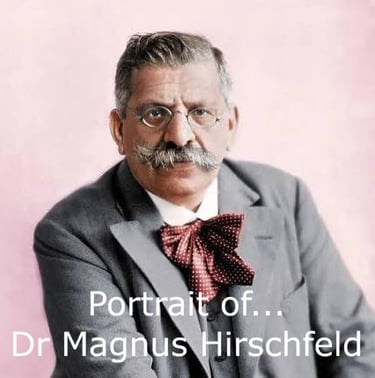
Portrait of... Dr Magnus Hirschfeld
If I were to asked you, when do you think the first Gender Identity Clinic was founded, you might suggest the seventies or perhaps even the sixties.
Well the sixties did indeed see the setting up of two Gender Identity Clinics, both in 1966, one at the Johns Hopkins Hospital in Baltimore, Maryland, USA, and the other at the Charing Cross Hospital, London, in the UK.
However they were both proceeded by nearly fifty years, and I apologise in advance to my German listeners for my no doubt poor German pronunciation throughout this episode, by the founding of the “Institut für Sexualwissenschaft”, the “Institute for Sexual Science”, in 1919, by Dr Magnus Hirshfeld.
Welcome to “Trans Wise Trans Strong”, I am Carolyne O’Reilly.
Episode sixteen, “Portrait of...Dr Magnus Hirshfeld”
It was on the 14th of May 1868 that Magnus Hirshfeld was born, in the city of Kolberg, Prussia, now called Kołobrzeg in Poland, but why the change of name and country, well this was as a result of a decision made at the Potsdam Conference in July 1945, which was the third and final conference that decided the fate of Europe after the Second World War.
The western Polish border was moved west into Germany, to be defined more or less by the Oder and Lusatian Neisse rivers, and eastern border was also moved West, when Poland conceded land to the USSR, and in fact Poland lost more land to the USSR than it gained from Germany.
And latterly grabbing land that was the sovereign territory of another nation was an act that the Russian Federation, which came into being following the demise of the USSR on the 26th of December, Boxing Day, 1991, must have thought was a good idea, Crimea anyone.
In fact the Crimea region figured in the second conference which was at Yalta in the Crimea in February 1945, which followed the first, which took place in November 1943 in Tehran, Persia which is now Iran.
Magnus came from a large conservative Ashkenazi Jewish family, his parent’s Friederike and Hermann had eleven children, including Magnus, although sadly four of whom died at a young age.
From a young age Magnus developed an interest in sex, believing sex was natural and wholesome, which was at odds with the conventions of the era in which he was growing up, and their early education was at the Kolberg Cathedral School.
Magnus’ father was a doctor, and although initially studying linguistics in Breslau from 1887 to 1888, in 1889 they followed in their fathers profession and began their medical studies at Strasbourg, and studied at a number of academic institutions before earning their doctorate in 1892 in Berlin.
It was during his medical training that the attitude towards gay people was brought home to the young Magnus by a so called lecture on “sexual degeneracy”, where a gay man was brought before the students, treated no better than an animal.
The man had been incarcerated in an asylum for 30 years, for just being gay, and unlike his colleagues, only Magnus was revolted by this treatment, and before you sneer at this 19th century attitude.
It wasn’t until the release of the “American Psychiatric Association’s” Diagnostic and Statistical Manual of Mental Disorders” DSM-V published in 2013, and the W.H.O.’s , “International Classification of Diseases ICD-11 in 2022, that there was not a single heading that could be applied based on a person’s sexual orientation.
And another sobering thought, today there are still 64 countries where being gay is criminalised.
After graduating with a medical decree, Dr Hirshfeld spent the next two years traveling the world lecturing and writing articles, visiting many countries, including the USA where they spent eight months, during which time they wrote about the 1893 World’s Columbian Exposition in Chicago for a German newspaper.
Magnus found many of the cities he visited including Chicago, had like Berlin, a queer subculture, which Christopher Isherwood wrote about in “Goodbye to Berlin”, published in 1939.
Isherwood’s novel was the basis for a 1951 play by John Van Druten, “I Am Camera”, 06:24 which itself was the basis for a 1972 film starring Liza Minnelli, the musical “Cabaret”.
Returning to Germany, aged 28 the young doctor Magnus took up residence in Charlottenburg, now a district of Berlin, in 1896, and unlike I suspect many of his contemporaries, Dr Hirshfeld was sympathetic towards the LGBTQIA+ communities and therefore it is unsurprising that they had a number of gay patients.
Dr Hirshfeld learnt that a number of their gay patients had attempted suicide, and it was on the cusp of the 20th century that late one evening in 1896 a young lieutenant sort out Dr Hirshfeld at the entrance to their practice in a very distressed state, asking to be seen.
They said they were “Urning”, a term coined by Karl Heinrich Ulrichs in 1864, which just preceded the coining of “homosexual” by Karl Maria Kertbeny in 1869, although now gay is generally preferred as homosexual has become a stigmatising term, due to its medical association and the pathologizing of being gay for much of the 20th century.
Dr Hirshfeld found that the young soldier was inconsolable, and after leaving him, tragically overnight, which was the eve of their wedding, which I would suggest they were forced into and could not face, they used a gun to commit suicide.
This tragedy had a profound impact upon Magnus not just personally for this needless loss of life, but professionally as it precipitated a change of direction for their professional life.
The soldier bequeathed his private papers to Hirschfeld, with a poignant covering letter, “The thought that you could contribute to a future when the German fatherland will think of us in more just terms, sweetens the hour of death”.
Now though, one cannot help but shudder at that phrase “the German fatherland”.
But why did this soldier and many of Dr Hirshfeld’s gay patients feel such despair, well it was due to the infamous “Paragraph 175” in the German criminal code which in 1871 made same gender relations illegal, a legislative act that the UK would follow with the passing into law of The Criminal Law Amendment Act 1885.
It was also in 1896 that Dr Hirschfeld published their first work, a pamphlet as a challenge to Paragraph 175, titled, here goes, “Sappho und Sokrates: Wie erklärt sich die Liebe der Männer und Frauen zu Personen des eigenen Geschlechts?”, “Sappho and Socrates: How Does One Explain the Love of Men and Women to Persons of Their Own Sex?”
Where they explored their theory that women and men each have a combination of masculine and feminine characteristics to a varying degree, to use a modern term, that gender identity exists on a spectrum, and also that same gender attraction was just as natural and innate, as opposite gender attraction.
And to obtain statistical proof of same gender attraction, and bisexual attraction, they conducted from 1901 to 1904 surveys of students and metalworkers on their sexual orientation.
These insights about gender identity and sexual orientation were somewhat lost to history, as the result of events that began in the early thirties in Germany.
It would be thirty-four years before the embarkation of another statistical survey, led by the American, Professor Alfred Kinsey which started in 1938, that would result in two land mark publications on the sexual behaviour of Americans in 1948 and 1953, with first “Sexual Behavior in the Human Male”, followed by “Sexual Behavior in the Human Female”.
Professor Kinsey’s pioneering work was brought to a wider audience by the 2004 film starring Liam Neeson, “Kinsey”.
It was in the Sexual Behavior in the Human Male, that the Kinsey Scale first appeared, devised by Dr. Alfred Kinsey, Dr. Wardell Pomeroy, and Dr. Clyde Martin.
The Kinsey Scale was a measure of sexual orientation that went from zero for a person exclusively heterosexual to 6 for a person who was exclusively homosexual.
Then in 1978, Dr. Fritz Klein published “The Bisexual Option”, where they expanded The Kinsey Scale into a multi-dimensional grid, devising the “Klein Sexual Orientation Grid”, where they added a temporal element, viewing sexual orientation in the past, present, and ideal.
Finally in 2009, my psychotherapist, Dr Kenneth Demsky gave a presentation of “The Klein-Demsky Matrix of Sex and Gender”. which you can find on The Beaumont Trust” website, where they built upon “The Klein Sexual Orientation Grid”, to include the variables of gender both psychological (gender identity) and physiological (anatomical).
But back to the 19th century, and 1897, when Dr Hirschfeld co-founded the “Wissenschaftlich-humanitäres Komitee”, Scientific-Humanitarian Committee with the publisher Max Spohr, the lawyer Eduard Oberg, and writer Franz Joseph von Bülow.
This was the worlds first LGBTQIA+ organisation, whose aim was to increase the understanding of queer people, through research, exemplified by their motto, “Justice through science”, a philosophy that seems somewhat alien to some of our world leaders, along with that other quaint concept, “truth”.
Dr Hirshfeld developed a good working relationship with the Berlin Police Department, helping them to understand the needs of gender non-conforming people, and issue a medical certificate to his transgender patients to protect then from harassment.
And an enlighten attitude was also demonstrated by Belin’s Chief of Police who subsequently issued permits to transgender people that gave express permission for them to dress in alignment with their gender identity, to protect them from potentially being arrested or charged with the criminal offence of exhibitionism.
When I first read this, it did make me feel slightly uncomfortably, that one needed a document to avoid harassment, although given that supreme Court ruling, and the wholesale roll back of hard won trans rights in it wake, I wonder will trans and nonbinary people be forced to wear some sort of a symbol, a pink triangle perhaps.
It was through his research into gender that he coined in 1910 the word “Transvestit”, “transvestite” as a medical and scientific term, now it is generally considered offensive, and one would now use the term crossdresser.
Dr Hirschfeld asserted that people who identified as “transvestites”, we would now use the term trans, were not necessarily attracted to members of the same sex, rather he argued that their gender identity was distinct from their sexual orientation, again instep with current understanding that gender identity and sexual orientation are two distinct psychological aspects of a person.
Dr Hirschfeld defined “transvestites” broadly as people who wore clothing of a different gender than that assigned to them after they were born.
Dr Hirschfeld also joined the feminist organization “Bund für Mutterschutz” (League for the Protection of Mothers) founded by Helene Stöcker in 1905, which alongside the Scientific-Humanitarian Committee campaigned unsuccessfully for the repeal of Paragraph 175, however they where successful in preventing in 1912 the criminalisation of being lesbian.
During, “The Great War”, which was yet to acquire an ordinal number, they served as a Red Cross physician, and the horrors they experienced led them to become a devote pacifist, and following that terrible conflict, the Weimar Republic came into being, which lasted until 1933, can’t think why it came to an end then.
It was during the first years of the Republic that in 1919 that Dr Hirschfeld opened the Institut für Sexualwissenschaft, the “Institute for Sexual Science” in a stately building in the central Tiergarten section of Berlin.
They also lived on the second floor of the building with their longtime partner, Karl Giese, who was a German archivist and became the institute’s director of what would become an extensive library and archive on sexuality.
Although Dr Hirschfeld had many gay patients they were not open about their relationship with Karl Giese, and later in their life they would be in a relationship with their protegee Li Shiu Tong, a Hong Kong medical student, sexologist, and LGBTQIA+ activist.
As well as being the world’s first Gender Identity Clinic, the institute could also claim to be where the first gender affirming surgery took place, however if you have seen 2015’s “The Danish Girl” you may have been left with the impression that it was Lili Elbe the Danish Girl, of the title, who was to have the first surgery.
However Lili Elbe’s surgery were proceeded by Dörchen Richter’s first surgery, which was an orchiectomy, the surgical removal of the testes, performed by the Berlin surgeon Erwin Gohrbandt in 1922.
Then in 1931 Dörchen, who was an employee at the Institute, had further surgeries there, a penectomy and vaginoplasty, the creation of a neovagina, by the gynaecologist Ludwig Levy-Lens and again Erwin Gohrbandt.
And there was the gender affirming surgery of Carla van Crist and Toni Ebel, however due to an event in 1933, which surgeries proceeded which is not certain, however Lili Elbe’s surgery I feel reasonably confident to say was not the first.
However I would not criticize the film for conflating the experiences of several people into one, as this is an acceptable narrative device, but I do have an issue with the casting of a cisgender male actor as Lili.
And spoiler alert if you have not seen the film or do not know about Lili Elbe’s life, following her final surgery in 1931 she died of infection-related complications.
And in fact Eddie Redmayn who portray Lili, latterly said in 2021 that now if offered the role they would not have accepted it, as even though they did it with the best intentions, it wouldn’t be right.
But 1922, the year of Dörchen’s orchiectomy, does seems to be a definite year that we can state that the first steps of gender affirming surgery were taken.
In 1930 Dr Hirshfeld embarked on a global lecture tour, leaving Karl in charge of the Institute, visiting the United States, Japan, China, the Philippines, Indonesia, India, Egypt, and Palestine, although a doubt if he was travelling today he would be able to visit modern day Palestine.
And following his world lecture tour, Dr Hirshfeld did not return to Germany, as being Jewish and gay, it was no longer safe to do so, and therefore settled in Switzerland, and not long after taking up residence, remember I mentioned an event in 1933, well before that event, there was another momentous one, when on the 30th of January 1933, a new chancellor of Germany was elected, one A. Hitler.
Then on the 6th of May the Institute for Sexual Science was ransacked by Nazi supporting youths, and four days later on the 10th of May, the contents of its library along with 20,000 other books were burnt in Berlin’s Bebelplatz
Square, and then a few months later the Institute itself was forced to closedown by the Nazi authorities.
From Switzerland Dr Hirshfeld moved to France, first staying in Paris where they were joined by Karl Giese and Li Shiu Tong, and then they moved to Nice, where Dr Hirshfeld died of a stroke in their apartment on the 14th of May 1935, their 67th birthday.
Karl and Li were named as the primary heirs of DR Hirschfeld's, however Karl would commit suicide on the 16th March 1938, however Li would live to the age of 86 dying on the 5th of October 1993.
And what of those Gender Identity Clinics founded in 1966, well the one at Johns Hopkins Hospital closed in 1979.
The reason given for its closure was in part a study by Dr. Jon K. Meyer which claimed, and I’ll use the current terminology, and slightly paraphrase, “found no objective evidence that there is a real difference in a transgender person’s adjustment to life in terms of jobs, educational attainment, marital adjustment and social stability through having gender affirming surgery”.
The study faced immediate criticism from the scientific community in regards of its scientific rigor, and it would be nearly forty years before gender affirming surgery would resume at the Johns Hopkins Hospital.
The London based clinic is now the Tavistock and Portman NHS Foundation Trust Gender Identity Clinic, and it was the location until the 31st of March 2024 of the home of the UK’s only dedicated gender identity clinic for children and young people.
The Tavistock’s Gender Identity Development Service (GIDS) for children and young people opened as a tiny specialist clinic in 1989, based at St George’s hospital, South London, with just four referrals, and subsequently became the world’s largest children’s gender clinic.
The closure of GIDS was precipitated by the Cass Review, which was conducted by Dr Hilary Cass, and in fact it was the interim report published in March 2022, that led to GIDS closure, with the final report published in April 2024.
April 2024 was also when two replacement services became operational in London at the Evelina London Children's Hospital and the North West of England at Alder Hey Children's NHS Foundation Trust.
I wont offer my opinion of the Cass Review but will point you to “An Evidence-Based Critique of the Cass Review”, by the Yale Law School and this sentence from its conclusion”..
Far from evaluating the evidence in a neutral and scientifically valid manner, the Review obscures key findings, misrepresents its own data, and is rife with misapplications of the scientific method…”
And finally I would like to end with a quote from Dr Magnus Hirschfeld.
“Soon the day will come when science will win victory over error, justice a victory over injustice, and human love a victory over human hatred and ignorance.”
Sadly I feel we are still waiting for Dr Hirschfeld’s hopes to come true, what do you think dear listeners.
Next time, “One Year of Trans Wise Trans Strong”