Transcript of Take Pride in Your Flag
During Pride month, one cannot fail to notice a proliferation of Pride flags, which may hang alongside a country’s national flag, some of which may be based on variations of the original Rainbow Pride flag, although I wonder if this year, 2025, during Pride month in the USA, will the Stars and Stripes flutter forlornly.
In this episode I will look at the origin and evolution of the Rainbow Pride flag and describe a Pride flag for each letter of LGBTQIA, and a few of the many other Pride flags which I feel might be worth highlighting.
A little while ago I compiled from various sources, a for different gender identities, sexual orientations and fetishes, and so far the total is, 59 wonderfully diverse flags.
Note: Since recording this episode, I have added another Pride Flag to the glossary.
Welcome to “Trans Wise Trans Strong”, I am Carolyne O’Reilly.
Episode two, “Take Pride In Your Flag”.
According to the Encyclopaedia Britannica, what we would now recognise as a flag, a shaped piece of material, dates back to the founder of the Zhou dynasty in China (1046–256 BCE), therefore we can say the first flag flew, some three thousand years ago.
Leaping forward to the late seventies, only a slight switch in eras, two names feature in the inception of the Rainbow Pride flag, one planted the seed and the other nurtured it into life, Harvey Milk and Gilbert Baker.
I’ll come back to Harvey, but first who was Gilbert Baker?
Gilbert Baker was born on the 2nd of June 1951 in Kansas, and had a love of art and music, studying art until at 19 in 1970, they were drafted into the army, where they became a medic, and during their time in the army they were careful not to reveal they were gay, and received an honourable discharge in 1972.
It was at this point that Gilbert told their family that they were gay, and they were promptly disowned!
They became a volunteer at the San Francisco Gay Community Center, and in 1975 Gilbert Baker first met Harvey Milk, but unlike Gilbert, Harvey had received an “Other Than Honourable” discharge from the Navy.
Forward to 1977, that was the year that Harvey Milk asked Gilbert Baker to create a symbol for the gay community, and Gilbert decided it should be a flag, what flag? and then the idea came to them while dancing at a venue full of colour and light; a rainbow.
I feel this unifying symbol, is the culmination of an event that happened at the end of the sixties, more of which later.
And so forward again to 1978, which was when Gilbert created the first two Rainbow Pride flags, with the help of Lynn Segerblom and James McNamara.
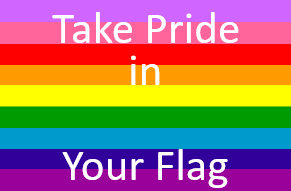
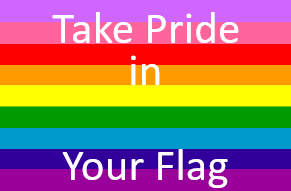
The flag was made up of 8 different coloured horizontal stripes, each colour representing an aspect and a diversity of the LGBTQIA+ community.
So what were the colours and importantly what did they stand for?
Well starting at the top, first there was hot pink and this represented sex, followed by red for life, orange for healing, yellow for sunlight, green for nature, turquoise represented magic and art, then indigo for serenity and finally violet for Spirit.
The two flags debut at the San Francisco Pride, flying from the Civic Centre on the 25th of June 1978.
But tragically, within 5 months of their creation, Harvey Milk was dead, having been assassinated.
Following the assassination, demand for the flag increased, but at the Paramount Flag Company, where Gilbert worked, not enough pink colour material could be sourced, therefore the hot pink stripe was dropped.
Before I move on, I would like to talk a bit more about Harvey Milk, who, was the first openly gay man elected to a public office, as a member of the San Francisco Board of Supervisors.
Harvey was born on the 22nd of May 1930, and studied maths and history at college and after graduating in 1951, enlisted in the Navy.
Harvey became a Navy Reserve officer in May of 1952, but in January 1955 they were forced to resigned for being gay, with, as mentioned, an “Other Than Honourable” discharge, as at the time and for the next forty years, there was a total ban in serving in the armed forces, if one was gay, lesbian, bisexual or transgender.
The same ban existed in the UK, from 1955 until the 12th of January 2000.
Whilst in the USA, the “Human Rights Campaign” website details a partial lifting, with the officially enforced federal policy, enacted from the 28th of February 1994, during Bill Clinton’s Presidency, coined, “Don’t Ask, Don’t Tell”, which applied to lesbian, gay, bisexual and transgender members of the armed services.
This policy was based on the utterly ridiculous assumption that this group of people would undermine the military’s ability to perform its duty.
This discriminatory policy was finally repealed during Barack Obama’s Presidency, on the 20th of September 2011, but for transgender people in the military, there was a twist in the tail, as on the 27th of January 2025, President Donald Trump, issued an Executive Order banning transgender people from serving in the military.
After their forced resignation from the Navy, Harvey had a varied career before opening a camera store on Castro Street, San Francisco, at the end of 1972, and in 1974 they run for public office, but lost, and ran again in 1975 but lost again, although this time only narrowly, and finally they succeeded in 1977, becoming a San Francisco City-County Supervisor on the 9th of January 1978.
Harvey was committed to serving the broader community, not just the LGBTQIA+ community and was an effective and popular supervisor.
Then on the 27th of November 1978, first Mayor George Moscone and then Harvey Milk, where assassinated by Dan White, a disgruntled former city Supervisor.
Following the double assassination there was a silent candle lit march, from Castro Street to City Hall by thousands of people.
As for the assassin, they were found guilty only of manslaughter, and were sentenced to less than eight years, and their defence was that, “eating too much junk food was responsible for their actions”, well if that had any validity, then why didn’t Morgan Spurlock go on a mass killing spree, twice.
Might I suggest that perhaps homophobia may have been a motivating factor.
And then there was six.
In 1979 the number of colours, of the Rainbow Pride flag was decreased again, a blue stripe replaced the turquoise and indigo, as a six colour flag could be easily split in half, a decision made by Gilbert, so that street lamps along the 1979 Pride Parade route could be decorated with the flag.
However the transformation into a six colour rainbow flag was not the end of its evolution, more anon.
Brick can build a wall of prejudice, but even a metaphorical brick, can break it down and be a catalyst for a revolution, as was the case in the early hours of Saturday the 28th of June 1969, at the Stonewall Inn, Christopher Street, New York City.
From the beginning of the sixties, harassment of the LGBTQIA+ community had increased, and the Stonewall Inn had already been raided earlier in the week.
So earlier on Friday night of the 27th, which was the hottest of the summer, it would take little for emotions to explode, and so around 1:00 am there was another police raid and the patrons, mostly gay men, where forced onto the street with demands to see their IDs.
Initially the mood was calm, perhaps it was felt, “oh well here we go again”, then a lesbian, was roughly manhandled into a police car, at which point all hell broke loose.
This time it was the police who were made to feel fearful, cowering and running back into the Stonewall, in the face of coins, bottles and stones, pretty much anything that could be thrown in their direction.
Around 2:00 am, a key figure in the gay rights movement arrived, joining the uprising, Marsha P. Johnson, who grew up in an African-American, working-class family, along with her friend Sylvia Rivera, who was Puerto Rican.
Marsha described herself as a gay person, a transvestite, and a drag queen, as although the word transgender had been coined in 1965, it was not in common usage; had it had been, I feel that both Marsha and Sylvia, would have described themselves as trans women.
As well as thrown objects, one was not thrown, but used to write three words that night, Marty Robinson gave his friend Mark Segal, a homeless teenager, a piece of chalk and asked them to write those three words, and what where they, “Tomorrow night Stonewall".
On the second night of the uprising, Marsha climbed a lamppost and shattered the windscreen of a police car, by dropping a heavy bag onto it.
The uprising lasted a total of six days, and in much the same way that, Rosa Parks’ refusal to give up her seat to a white man on an Alabama bus, on the 1st of December 1955, galvanised the civil rights movement, the Stonewall Uprising set in motion the gay liberation movement.
And I believe that Harvey Milk’s wish for a unifying symbol for the gay community, was a natural consequence of all that followed the events at Stonewall those barmy summer nights.
The importance of Stonewall is commemorated by the Stonewall National Monument in New York City, oh and remember Marsha P. Johnson, the trans woman who was there, and who would become a key figure in the gay rights movement.
Not that you would know it now, if you check the National Park Service’s web page for the Stonewall Monument, it now reads in part, “The Stonewall Uprising of June 28, 1969 is a milestone in the quest for LGB civil rights and provided momentum for a movement.”
The acronym used to be, “LGBTQ”, the involvement of trans and queer people in the uprising has been erased, much like in the Soviet Union, where people who fell out of favour were erased from history, or like in 1984.
The National Park Service’s Monument web page, is not the only area where trans people have been erased, the Center for Disease Control is erasing mention of queer, intersex and transgender individuals, and they are not alone, it seems the current US administration perceive 1984, not as a warning, but as a user manual.
And back to flags.
However, before discussing how the six stripped Rainbow flag has been modified, I would like to mention one last design change to the original, when Gilbert Baker added a lavender stripe, representing diversity, above the hot pink stripe.
Gilbert created the flag in response to the election of Donald Trump, for the first time, not that they would know, as they died shortly after its creation, on the 31st of March 2017.
They made 39, for the 39th anniversary of the Rainbow Pride flag, to be displayed in San Francisco during June’s Pride month.
The first evolution of the Rainbow Pride flag, was the Philadelphia Pride flag, which was unveiled on the 8th of June 2017 at the Philadelphia City Hall, to commemorate the start of Pride month.
Two additional stripes were added to the top of the flag, black followed by brown, which represented Queer People of Colour, it was created by the PR agency Tierney, based in Philadelphia, for the campaign, “More Colour More Pride''.
The addition of the black and brown stripes was seen as a small but powerful step for inclusivity in the LGBTQIA+ community.
The next change was built upon the Philadelphia Pride flag, it is the Progress Pride flag and was created by Daniel Quasar, artist and graphic designer, in June 2018.
The black and brown stripes were moved to the left as a right pointing chevron, to signify forward movement within the LGBTQIA+ community, with first black and then brown behind it.
As well as representing Queer People of Colour, the black stripe was also an acknowledgment, of the thousands of lives lost due to the HIV/AIDS crisis in the 1980s and 1990s, from the community.
Behind the brown chevron, representing the trans community, were two more chevrons, first light blue and then pink, followed by a white triangle.
The latest evolution of the flag builds upon the Progress Pride flag, and it is the Intersex-Inclusive Progress Pride flag, and dates to 2021, it was designed by Valentino Vecchietti of the Intersex Equality Rights UK, by adding the Intersex Pride flag.
The white triangle became another chevron, and behind it representing Intersex, is a yellow triangle with a purple circle.
Quoting the Pride Flag page of the, “University of Northern Colorado”, Vecchietti said, “My intention in creating this iteration of the flag, with visible intersex inclusion, is to create some much-needed intersex joy. We also hope that it will increase allyship from the LGBTQA community”.
And speaking of LGBTQA and I+
L is for Lesbian
A woman who is, romantically, sexually, attracted to a woman, may well use the word “Lesbian” to describe herself, the word literally means a resident of the Greek island of Lesbos, and Lesbos was where the Greek poet Sappho, who wrote beautiful poems expressing her love for women, was born, during the early decades of 600 BCE, and the word sapphic is derived from her name.
Lesbian in the sense we use it today can be traced to its origin, at the end of the 19th century, and before that, the term “sapphic”, was used for women who love women.
Women adopted lesbian in the late 1960s to differentiate themselves from gay men.
There are several variations of the lesbian flag, reflecting the diversity within the lesbian community and a widely known one is from 2018, created by Emily Gwen, the Sunset Lesbian Pride flag.
It has seven horizontal stripes, the top three range from dark to light orange, then a middle band of white, and the lower three, range from pink to the bottom purple.
The orange shades represent independence and community, whilst the white represents relationships that are unique and diverse, and the pink and purple shades represents the diversity of love, femininity, and serenity within the community.
G is for Gay
Well more precisely, gay men.
The first flag that was created as been superseded by one that is trans inclusive and this is the Trans-Inclusive Gay Men’s Pride flag, created by user “gayflagblog” on the 10th of July 2019.
It also consists of seven horizontal stripes, with the top three coloured green to represent community, then light green for healing and next teal for joy in nature.
The middle white stripe represents those who are transgender, nonbinary or gender non-conforming.
With the lower half, light blue followed by dark blue and then purple, which represents the wide range of gay men.
B is for Bisexual
The word bisexual is derived from the Greek bi, meaning two, and represents romantic and physical attraction to two genders.
The Bisexual Pride flag was created by Michael Page, debuting on the 5th of December 1998, at the 1st anniversary party of BiCafe, an early bisexual website, Michael created the flag following their time at a nonprofit organization, BiNet USA, and their aim for the flag was to differentiate the bisexual community from the Rainbow Pride flag and gay community.
It consists of two broad horizontal stripes either side of a narrow one, the top stripe is pink to represent the attraction to the same gender, the middle is purple, representing attraction to two genders, and the bottom stripe is blue, representing attraction to those who identify as a different gender.
T is for Transgender
The Transgender Pride flag, first flew at the 2000 Phoenix Pride Parade.
A year before, it was created by Monica Helms, a trans woman and US Navy veteran, and it represents people whose gender identity, differs from the sex they were assigned at birth, and the diversity of the trans community.
The flag consists of five horizontal stripes, the top and bottom are pale blue and either side of a central white stripe, are light pink stripes.
The light blue represents a traditional colour for boys, and likewise, the light pink represents a traditional colour for girls, although now one might consider both these colours to be stereotypical representations, of maleness and femaleness, that said, I still think it is an attractive looking flag, although as a trans woman, I am perhaps a bit biased.
And the central white stripe, this represents intersex, I was going to suggest perhaps now one might say DSD, Differences of Sex Development, although having recently read an interesting article, which I feel is worth reading, The differences between intersex and DSD on thisisintersex.org website, I am not so sure about making such a suggestion.
White also represents transitioning, or having a neutral or undefined gender.
The first flag that Monica created, now flies proudly in the Smithsonian Natural Museum of American History, which I would suggest cements its place in trans history.
Over time, its symbolic importance to the trans community has increased, and on the 19th of November 2012, it was flown in the Castro District, of San Francisco, to commemorate Transgender Day of Remembrance, and during June’s 2016 Pride month, it was displayed in the White House.
I think I can suggest with confidence, that the White House during June 2025, will be sans Trans flag, as no doubt will be the case for 2026 to 2028.
Q is for Queer
The Queer Pride flag was created in 2015 by Pastelmemer and represents all aspects of being queer.
Queer is used by those who feel their gender identity, gender expression, sexual orientation, do not fit neatly into given cultural norms.
It has 9 horizontal stripes, the top and bottom are black, and the middle stripe is white, and these colours represent those on the asexual, aromantic, and agender spectrum, and the second and third stripe from the top are light and dark blue which represents same-gender attraction.
Either side of the white stripe, is a green stripe above, and an orange stripe below, which presents nonbinary individuals, and above the bottom black stripe, is a light pink stripe, and above that is a dark pink stripe, representing same-gender attraction.
I is for Intersex
The intersex flag first flew on the 5th July 2013, it was created by Morgan Carpenter, then co-chair of Organization Intersex International Australia.
Morgan explored several different designs but none felt right, as they wanted a flag with a commonly understood symbol and to be firmly grounded in meaning; finally they came up with a flag that has a yellow background and centred on the middle is a purple circle.
The yellow and purple were chosen as gender neutral colours, and the circle represents wholeness, completeness and intersex people’s potentiality.
Lastly A is for Asexual
The lack of sexual attraction to all genders.
The flag was created in 2010 by an Asexual Visibility and Education Network (AVEN) user, named “standup”, who won a contest run by the AVEN, for a pride flag to represent those who identify as asexual.
It has 4 horizontal stripes, with a black stripe at the top that represents asexuality, followed by grey for grey-asexuality and demi-sexuality, then white for non-asexual partners and allies, and lastly purple which represents community.
There are a few other Pride flags I would like to mention.
The Nonbinary Pride flag
This flag preceded the creation of the Trans Pride flag by five years, it was created by Kyle Rowan in February 2014, and it represents people whose gender identity is neither wholly female or male, and counters the assumption, that gender is strictly binary, either male or female, and that assigned sex at birth represents an individual’s gender identity.
The Nonbinary Pride flag should not be seen as an adjunct to the Genderqueer flag, that proceeded it by 3 years, but rather as complimentary to it, both flags can be flown together.
It has four horizontal stripes, which are top to bottom; yellow, white, purple and black.
The yellow represents those whose gender falls outside being either male or female and without referencing binary gender, white are people of many or all genders.
The purple represents those whose gender identity exists somewhere between male and female or a mixture of them, and black for those who do not feel they actually have a gender.
The Genderqueer Pride flag
Genderqueer people’s gender identity is neither male or female, and doesn’t fit within the male and female binary dichotomy.
The flag was created by Marilyn Roxie in June 2011, with the aim to create visibility for the genderqueer community and related identities.
It was initially meant to represent all nonbinary and genderqueer people, but with the growth of the community, the flag became more specifically associated with genderqueer, resulting in nonbinary people feeling that they were no longer represented by the flag.
This led to the creation by Kyle Rowan, as I mentioned, of a flag specifically for the nonbinary community in February 2014.
The genderqueer flag has three horizontal bands, the top is lavender, which represents androgyny, and people who identify is a mixture of female and male, lavender being a mixture of blue and pink.
The middle band is white, representing agender people, and the bottom is dark chartreuse green, yes I had to look up that colour, Chartreuse is the colour of a French liqueur, a sort of yellow green.
Dark Chartreuse Green is the inverse of lavender and represents people who identify outside of and without reference to the gender binary.
The Two-Spirit Pride flag is the final flag I would like to describe.
The concept of two-spirit, existed before European colonisation of North America and is an umbrella term for queer identifying Native American individuals, with a traditional and cultural understanding of gender roles and identity.
I say colonisation, but perhaps cultural genocide might be more appropriate, as a cis-hetronormative belief was imposed by the settlers.
I believe that the two-spirit concept, illustrates the acceptance of gender identities other than cisgender, which is the belief that gender identity and assigned sex are the same, and of sexual orientations other than straight.
Therefore, I believe that the two-spirit concept, illustrates that a spectrum of gender identities and sexual orientations is not a modern one.
The Two-Spirit Pride flag is based on the six colour Rainbow Pride flag, with two black and white feathers attached to a white circle centred on the orange stripe.
The feathers represents masculine and feminine identities, and the circle represents the unification of masculine and feminine identities into a separate gender.
It cannot be underestimated how powerful a flag can be, or that over time its design may change, as illustrated by the Rainbow Pride flag, with each iteration, adding new meaning, and inclusivity.
It can also be a unifying symbol, particularly for a community that feels under oppression, which is how I imagine the trans and nonbinary community must feel in the United States, at this present time.
Also, the Rainbow Pride flag, acted as a catalyst for other Pride flags, representing the incredibly wonderful diversity, of the LGBTQIA+ community.
This episode was written and presented by me, Carolyne O’Reilly, thank you for listening.
Next time, “The New Eugenics”.