Transcript of The Kings and Queens of Drag
Drag Queens and perhaps to a slightly lesser extent, Drag Kings, are a familiar part of the diversity of entertainment, but have you ever wondered about the origin of the word “Drag”.
There is some debate as to its origin, for one possible answer we need to look back to the time of Shakespeare, as then all female roles were portrayed by male actors, and it seems the word drag may have originated from the dresses that they wore, that, dragged across the floor, hence, drag.
Another possibility dates not so far back, to the latter half of the 19th century, as this was the first recorded usage of drag, but who was the first drag queen or kin
Welcome to “Trans Wise Trans Strong”, I am Carolyne O’Reilly.
Episode six, “The Kings and Queens of Drag”
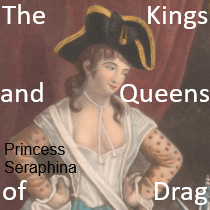
A possible candidate for being the first drag queen, would be found in 18th century Britain, it was Princess Seraphina, the alter ego of John Cooper, although perhaps describing her as a trans woman would be more accurate.
By day they worked as a gentleman’s servant, but by night they shone as Princess Seraphina in the late 1720s, and was a familiar face of, in modern terms, the gay community.
But then, and until, unbelievably, the late 1960s, in Britain, it was illegal to be gay if one was male, but in the 18th century there were some taverns known as Molly houses, perhaps the closest equivalent today would be gay bars, where gay men could meet in relative safety.
I say relative, as because during the 18th century being a gay man could result in execution, or as I refer to it, state sanctioned murder.
Interestingly, being lesbian was never criminalised, which is not to say women in a same sex relationship, didn’t experience prejudice to some degree, and like their straight sisters also had to deal with, then as now, misogyny, sexism, lower pay, you get the picture.
Princess Seraphina could have been lost to history, if it was not for being the survivor of an assault by a cisgender man, Thomas Gordon, who robbed her at knifepoint, stealing her clothes and jewellery.
And remember the enlightened 18th century attitude to being gay, Gordon threaten to report her for sodomy, but did Princess Seraphina backdown, no she did not, she reported the crime.
At the trial of Gordon, she was accepted and even celebrated as a woman, with witnesses when referring to her, using the correct she/her pronouns; I will hold off for a moment before revealing the verdict, as I would like to mention another much more recent legal case.
In February 2025 there was an employment tribunal case involving a NHS hospital in Scotland, and a cisgender female nurse and a trans woman doctor, were the judge allowed the use of incorrect gender terms by the nurse’s legal team.
However, the judge did allow the doctor’s legal team to use the correct ones, well, “whoop-de-doo”.
The employment tribunal will give their verdict in July 2025.
So a 21st century court was less enlightened, than an 18th century one, a century were one could be hanged for stealing five shillings, equivalent to thirty pounds today.
That an employment tribunal permitted the use of incorrect gender terms and pronouns might not seem much, but as with the recent supreme court ruling that trans women and men, are not women and men, illustrates a worrying trend of erasing a particular minority from society.
Whilst the trend is not at Gilead level, the changes in “The Handmaids Tale” that led to Gilead, were initially slight and were met with only a small minority of protest, to paraphrase Edmund Burke, “The only thing necessary for the triumph of evil is for good people to do nothing.”
But back to Princess Seraphina, well I am sad to say that Gordon was not found guilty of robbery, but even though there was no conviction, I hope Seraphina found solace by the respect that the court showed to her, 18th century one, 21st century zero.
Although the origin of the word drag is debated, the origin of the phrase drag queen is perhaps not, it was William Dorsey Swann, born in 1860, an African-American born into servitude, who described themself as, “a queen of drag”, hence drag queen.
It was three years after Swann’s birth that on the 1st of January 1863, Abraham Lincoln’s enacted the Emancipation Proclamation.
Swann began hosting drag events in their 20s, and it was at one party, in April 1888, that the police raided and whilst many ran away, Swann was one of the few who did not, and in fact confronted the police, they along with the others that the police captured, were taken to gaol.
Swann’s biographer, Channing Gerard Joseph, noted that their arrest in 1888, was the first recorded instance of resistance to queer oppression in American history.
Lincoln’s Emancipation Proclamation did not mean that African-Americans, were free from threats of violence, and some from the African-American community felt that traditional gender norms would enable a better chance to prosper, therefore Swann was a challenge to both within and without their community.
Newspaper articles of the time described Swann as “The Queen”, and Swann faced further arrests for hosting drag parties, and was convicted in 1896, and sentenced to 300 days in gaol, which they appealed against, but were unsuccessful, non the less, their place in history as America’s first queer activist was assured.
Whilst William Dorsey Swann, faced persecution for being a drag queen, another American, Julian Eltinge, who I feel it would be more accurate to describe as a female impersonator, would go onto great success in the early 20th century.
They were born in 1891, in Butte, Montana and started dressing in female clothes from an early age and as a teenager performed in local saloons, but paternal anger resulted in a move to Boston, where a producer spotted them and brought them to New York, were they performed in Vaudeville, known as variety theatre in the UK.
Their big break came in a Broadway musical, which although a flop, their performance was a success, and after many more shows they went west to Hollywood.
Eltinge had a great success, both artistically and financially, touring the United States and Europe, however with the start of the Great Depression in 1929, and the decline of vaudeville through the thirties, their career and wealth diminished and in 1941 they died just 60 years old.
A performer that was very familiar to British audiences was Danny La Rue, born in 1927, and similarly to Eltinge, would be better described as a female impersonator as opposed to a drag queen, and their career took off in the 1950s.
They were famous for a host of female celebrity characterisations, such as; Elizabeth Taylor, Zsa Zsa Gabor, Judy Garland, and their impressions were a more heightened representation of these famous women.
They once owned a nightclub, and performed on stage and in films but it was their television shows that brought them to a wider British audience.
During the 1970s, Danny starred in a number of series and also had their own Saturday night, live show from the London Palladium.
Another performer whose career also began in the fifties, would give birth to perhaps the most famous Dame in the world, who started as a humble Melbourne housewife, I give you Dame Edna Everage, a creation of Barry Humphreys.
Edna’s Damehood was bestowed at the end of the 1974 film, “Barry McKenzie Holds His Own”, by the then Australian Prime Minister, Gough Whitlam, who had a cameo at the end of the film.
Edna’s stardom continued to rise through the eighties and nineties, with Dame Edna notable for her celebrity interviews, asking questions that Barry Humphreys probably could not have gotten away with.
Another drag queen I would like to mention is Divine, who starred in many of the films directed by John Waters, during the 1970’s, films that most definitely fell under the category of cult, however Divine would go on to feature in one of Waters more mainstream and commercially successful films, 1988’s Hairspray.
A film that brought drag queens to a wider audience was 1994’s, “The Adventures of Priscilla, Queen of the Desert”, which starred Terence Stamp, not I would suggest, obvious casting as Bernadette a trans woman, and as drag queens, Hugo Weaving as Mitzi and Guy Pearce as Felicia.
The trio travel across Australia to Alice Springs in a bus to perform at a resort managed by the wife of Guy Pearce’s character, and who was Priscilla, she was the name of the bus.
Forward to the 21st century, I would like to mention lastly a musical, “Everybody's Talking About Jamie”, which was inspired by a documentary, “Jamie: Drag Queen at 16”, which followed Jamie, overcoming prejudice, to shine as a drag queen, and in 2021, a film of the musical was released.
Having spoken about drag queens, what of drag kings.
Drag kings are perhaps not as familiar as drag queens, and the phrase is more recent, first appearing in print, in the book, “The Queens Vernacular: A Gay Lexicon” by Bruce Rogers, which was published in 1972.
Before then, male impersonator was used and as to who was the first, well Bessie Bonhill, might lay claim to being the first.
They were born in the West Midlands and first began performing at a very young age, seven, as a principal boy in pantomime in 1862, and then progressed to performing as a number of boy characters, and their act also included singing songs, written for them by Arthur West, a friend of Charlie Chaplin.
But they would not remain in England, and in 1889, a New York theatre owner, Tony Pasto, saw their act and invited them to the USA, where they were a great success, and two years later they permanently moved to America, were their success continued until illness put an end to them performing.
They died at a very young age, 47.
Whilst Bessie Bonhill may well have been the first male impersonator in England, they were proceeded to America by a fellow country person, Annie Hindle, who was the first male impersonator to perform on variety stages there, in 1868.
Annie placed an ad proclaiming, with all due modesty, “the greatest male impersonator”, so perhaps not so modest.
However, perhaps the most famous male impersonator was, Matilda Alice Powles, don’t recognise the name, well perhaps their stage name may be more familiar, Vesta Tilley.
They were very successful, with a career that spanned the Victorian and Edwardian ages and was one of the highest paid performers in British Music Halls and they also performed in the States, with six successful tours, having been invited by the same theatre producer, who had invited Bessie Bonhill, Tony Pasto.
Tilley’s career lasted over fifty years, and whilst still performing married Walter de Freece, a British theatre impresario in 1890.
Walter would become a member of parliament, and when he retired he and Vesta spent the rest of their lives in Monaco.
And what about today, the greater awareness of drag can be summed up in three words, “RuPaul’s Drag Race”, which along with the original US version, has flourished into 16 international versions.
RuPaul’s show has brought drag to a global audience, and one hopes has led to a greater understanding of drag performance, although not all would welcome this I imagine, particularly those US states who do not so much embrace pink elephants, but red ones.
These states have seen legislative moves, to class drag performance as adult entertainment, seriously, if the impact of this was not so serious for the livelihoods of many gifted entertainers, it would almost be funny.
But this, along with banning trans people from serving in the military, government documents no longer reflecting an individual’s true gender, and even banning drag performance on military bases, illustrates a continuingly worry trend to ostracize trans, nonbinary, intersex and gender non-conforming people.
In Britain there is belief by some that the Americans do not understand satire, given that America elected Donald Trump for a second term, I think it’s safe to say that America that gets satire.
This episode was written and presented by me, Carolyne O’Reilly, thank you for listening.
Next time, “Celebrating Trans Films”